
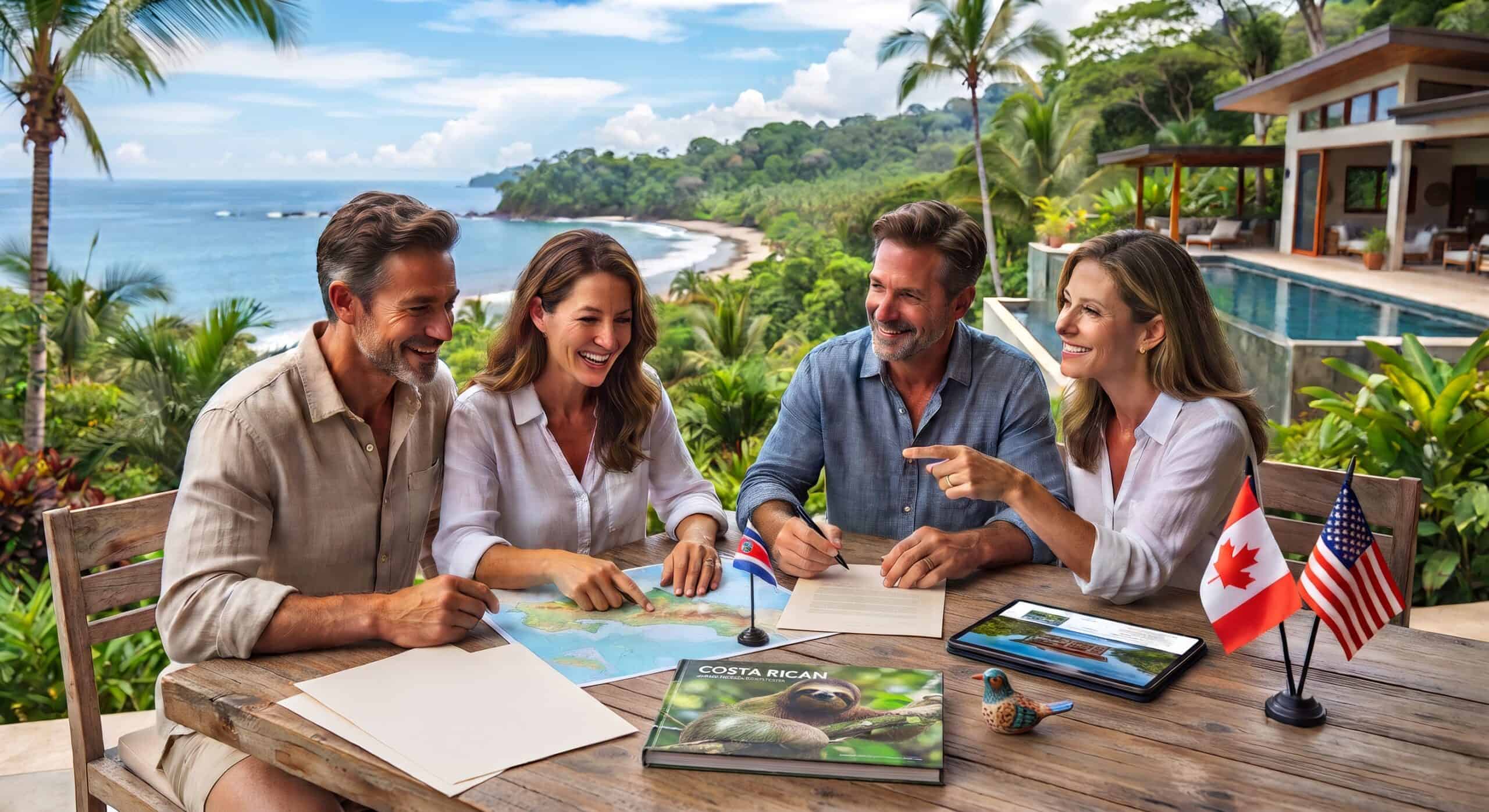
Dreaming of a home overlooking the Pacific, a plot of land in the jungle or an eco-lodge to run? Good news: buying property in Costa Rica is one of the most accessible real estate moves in Latin America for foreigners. No residency, no local partner and no special permit are required. There are, however, a few rules you absolutely need to know, especially about the maritime zone, closing costs and your tax obligations back home. Here is everything you need before you start.
Can foreigners buy property in Costa Rica?
Yes. Americans and Canadians can buy titled property in Costa Rica with just a passport, on the same terms as Costa Rican citizens. There is no minimum investment, no residency requirement and no need for a local partner. Private property is protected by the Constitution and recorded in the National Registry (Registro Nacional).
You can buy in your own name or through a Costa Rican company (S.A. or S.R.L.). A company offers privacy and can make a future resale simpler, but it comes with an annual corporate tax, a beneficial ownership filing and bookkeeping. Note that if you plan to apply for investor residency, the property generally needs to be in your personal name.
Rule number one: the maritime zone
This is the point every beachfront buyer must understand. Along the coastline:
- The first 50 meters from the high tide line are public: no one can build on them or own them.
- The next 150 meters form a restricted zone, granted by municipalities as a concession, which is a lease from the state, not ownership.
A foreigner cannot hold a majority interest in a concession without at least five years of legal residency in Costa Rica. Some listings use “title” loosely for concession property, so always have your lawyer confirm whether a property is titled or held under concession. Beyond 200 meters, property is titled as usual.
Step by step: how to buy in Costa Rica
- Choose the property and make an offer. A letter of intent sets the price, deposit and conditions.
- Place the deposit in escrow. Use an escrow agent registered with SUGEF, the banking regulator, never the seller’s account.
- Have your own lawyer run due diligence. Your lawyer should represent only you. They check the land registry (mortgages, easements, litigation), the cadastral survey, municipal taxes and water access.
- Check water availability. To build, you need a water availability letter from the local ASADA or AyA. Without one, a lot may be unbuildable.
- Sign the deed before a notary. In Costa Rica, the notary is a licensed lawyer who drafts the deed of sale.
- Record the deed in the National Registry. You officially own the property once it is recorded.
Plan on 30 to 60 days between an accepted offer and closing, depending on the complexity of the file.
How much does it cost? Closing costs to budget
| Item | Typical amount |
| Transfer tax | 1.5% of the price or fiscal value (whichever is higher) |
| Stamps and Registry fees | about 0.5% to 0.8% |
| Notary fees | about 1% to 2%, plus VAT |
| Escrow | about 0.25% or a flat fee near $1,000 |
| Total | about 3.5% to 5% of the price |
How costs are split between buyer and seller is negotiable, and they are often shared. One important tip: never declare a price lower than what you actually paid. It is illegal, and it will increase your taxable gain when you sell.
Taxes once you own
- Municipal property tax: 0.25% per year of the registered fiscal value.
- Luxury home (solidarity) tax: in 2026 it applies to construction valued above 143 million colones (about $318,000), at 0.25% to 0.55% on the amount above that threshold.
- Rental income: 15% applied to 85% of gross rent, or the general regime with actual expenses deducted.
- Capital gains on resale: 15% of the gain. For property acquired before July 2019, a 2.25% option on the sale price is available. A primary residence is exempt.
Can buying property get you residency in Costa Rica?
Yes, there are several options:
- Investor (Inversionista): an investment of at least $200,000, for example in real estate. The reduced $150,000 threshold expired in July 2026 unless Congress renews it.
- Pensionado (retiree): a lifetime pension of at least $1,000 per month.
- Rentista: stable income of $2,500 per month, or a $60,000 deposit in a Costa Rican bank.
Residents must contribute to Costa Rica’s public health system (CCSS). Permanent residency can be requested after three years.
What Canadians need to know
- Worldwide income: Canada taxes your worldwide income. Rent earned in Costa Rica must be reported in Canada, usually with a credit for tax already paid there.
- Form T1135: if your property is rented out and its cost exceeds CA$100,000, you must report it every year. A vacation home used strictly for personal purposes is not included.
- Capital gains: selling a vacation home in Costa Rica can trigger a taxable capital gain in Canada.
- Provincial health coverage: most provinces require you to be present about six months a year. Keep this in mind if you plan to spend much of the year in Costa Rica.
What Americans need to know
- Citizenship-based taxation: the US taxes its citizens wherever they live. Rental income goes on Schedule E, and the property is depreciated over 30 years.
- FBAR and FATCA: directly held real estate is not reportable, but Costa Rican bank accounts are once their combined balance exceeds $10,000 during the year.
- Costa Rican company: holding the property through an S.A. triggers additional, costly US filings. Talk to your tax advisor before choosing a structure.
- Resale: the gain is calculated in US dollars. Tax paid in Costa Rica can be offset through the foreign tax credit.
Our 5 tips before you buy
- Hire an independent lawyer who works for neither the seller nor the agent.
- Never transfer money outside a registered escrow.
- Check water and road access, especially for land.
- Visit during the rainy season to see the real condition of the roads.
- Choose your ownership structure with a tax advisor from your home country.
Frequently asked questions
Do I need residency to buy property in Costa Rica? No, a valid passport is enough.
Can I get a mortgage in Costa Rica? It is possible but difficult for non-residents. Most foreign buyers pay cash or finance from their home country.
How long does a purchase take? Usually 30 to 60 days between an accepted offer and registration.
Can I buy on the beach? Yes, but within 200 meters of the shoreline it is a concession, not ownership, with limits for foreigners.
Find your property in Costa Rica with Brymmo
Brymmo helps North American and European buyers with their Costa Rica projects, from choosing the property to closing. Browse our houses and villas, our hotels and lodges or all our properties, and get in touch to talk about your plans.
This article is for information only and does not constitute legal or tax advice. Rules change: have your project reviewed by a Costa Rican lawyer and a tax advisor in your home country. Information current as of October 2026.